Nicholas Carr Does It Matter Pdf Merge
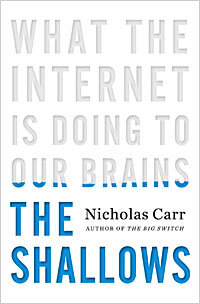
“Is Google making us stupid?” When Nicholas Carr posed that question, in a celebrated Atlantic Monthly cover story, he tapped into a well of anxiety about how the Internet is changing us. He also crystallized one of the most important debates of our time: As we enjoy the Net’s bounties, or are we sacrificing our ability to read and think deeply? Now, Carr expands his argume “Is Google making us stupid?” When Nicholas Carr posed that question, in a celebrated Atlantic Monthly cover story, he tapped into a well of anxiety about how the Internet is changing us. He also crystallized one of the most important debates of our time: As we enjoy the Net’s bounties, or are we sacrificing our ability to read and think deeply? Now, Carr expands his argument into the most compelling exploration of the Internet’s intellectual and cultural consequences yet published. As he describes how human thought has been shaped through the centuries by “tools of the mind”—from the alphabet to maps, to the printing press, the clock, and the computer—Carr interweaves a fascinating account of recent discoveries in neuroscience by such pioneers as Michael Merzenich and Eric Kandel. Our brains, the historical and scientific evidence reveals, change in response to our experiences. Protel 99se Free Download Crack.
The technologies we use to find, store, and share information can literally reroute our neural pathways. Building on the insights of thinkers from Plato to McLuhan, Carr makes a convincing case that every information technology carries an intellectual ethic—a set of assumptions about the nature of knowledge and intelligence. He explains how the printed book served to focus our attention, promoting deep and creative thought. In stark contrast, the Internet encourages the rapid, distracted sampling of small bits of information from many sources. Its ethic is that of the industrialist, an ethic of speed and efficiency, of optimized production and consumption—and now the Net is remaking us in its own image.

We are becoming ever more adept at scanning and skimming, but what we are losing is our capacity for concentration, contemplation, and reflection. Part intellectual history, part popular science, and part cultural criticism, The Shallows sparkles with memorable vignettes—Friedrich Nietzsche wrestling with a typewriter, Sigmund Freud dissecting the brains of sea creatures, Nathaniel Hawthorne contemplating the thunderous approach of a steam locomotive—even as it plumbs profound questions about the state of our modern psyche. This is a book that will forever alter the way we think about media and our minds. @Tom, the title makes the book sound more melodramatic than it really is. Marumalarchi Movie Songs Free Download. The book is wonderful and made me think really deeply about how our use of @Tom, the title makes the book sound more melodramatic than it really is. The book is wonderful and made me think really deeply about how our use of any technology shapes us (how we think, what we think, etc) and how technology can even shape the experience of reading a book (reading a ebook vs a traditional book). The author pulls heavily from Marshall McLuhan-like thought about technology, which helps ground the book in the work of a really great 20th century thinker.
Anyway, while I was reading it, I was unsurprised to come across some comments from Nicholas Carr, whose new book The Big Switch: Rewiring the World, from Edison to Google. One of the reasons Carr's book will be high up on my end of the year list of best tech books has nothing to do with substance. Unformatted text preview: THE SHALLOWS ALSO BY NICHOLAS CARR The Big Switch: Rewiring the World, from Edison to Google Does IT Matter? Our isolated, fragmented selves, locked for centuries in the private reading of printed pages, were becoming whole again, merging into the global equivalent of a tribal. Do you agree with the argument made by Nicholas Carr to support his position that IT nolonger gives companies a competitive advantage? Apr 01, 2004 Does IT matter? Nicholas Carr has foisted an existentialist debate on the mighty information-technology industry. The Economist explains.
I think the book made me more conscious about how my environment shapes me and think deeper about how I spend my time. I didn't feel guilty or terrified however. But I probably have cut back on reading online a bit and increased my reading offline. For the last few years, I've noticed that I seem to have developed a form of ADD. This was always the most apparent during the first few weeks of summer vacation when I would start and stop projects with lightning speed, when I couldn't sit still to read a book or watch a movie all the way through, when I couldn't clean my house all in one day, when I couldn't keep my mind on just one train of thought. As someone who had always lived for structure, who craved the routine and the predictable, who For the last few years, I've noticed that I seem to have developed a form of ADD.